
Surf's Up for Boults in San Diego
Match & technique analysis of Katie Boulter d. Marta Kostyuk (5-7, 6-2, 6-2)

Boulter’s resurgence inside the top 100 continues to propel her to new heights, as a career-best week in California elevates her into the top 30 for the first time. She secured as many top 30 wins en route to the final as she had done in her career to date, not to mention this was all achieved on a hard court – a surface she had never beaten a top 30 player on prior to this year (now 5-1 on the year; 0-10 pre-2024).
So, it seemed worthwhile to dig in to the details of a match that capped off such a spectacular week from the Brit. Below will be a deep dive into both the technical setups of the two players, and how it influenced the ebbs and flows of this 3-set final.
Before I get into all of that, I want to give a big thanks to TennisInNumbers, who kindly allowed me to use some of their extensive data points from the match. Their piece has tons of great data and graphics I didn’t manage to fit in, so it’s a worthwhile read.
Serving
Both players’ serves certainly suffered in the opening set, with a common denominator across both’s setups being a high ball toss.
With a high ball toss, timing your contact is that bit harder as it’s more difficult to ensure the centre of the racket face meets the ball during its heavy descent. This can result in wildly overcooked and wildly undercooked serves.
Such a high ball toss is also not easy to measure, either. So, it wasn’t a surprise to see many aborted ball tosses throughout. And, with such uncertainty that this adds in high-pressure moments, the cost can be seen in the resulting double faults.
Worse for Marta, beyond height differential, is the position her racket head takes up in the buildup. Here’s a comparison of the pair’s service motions.
What’s important to note is the path the racket takes on its way up. Marta’s shoots straight up and stops over her head, whereas Katie brings hers up more gradually and from the outside, allowing her racket to move continuously through to contact.
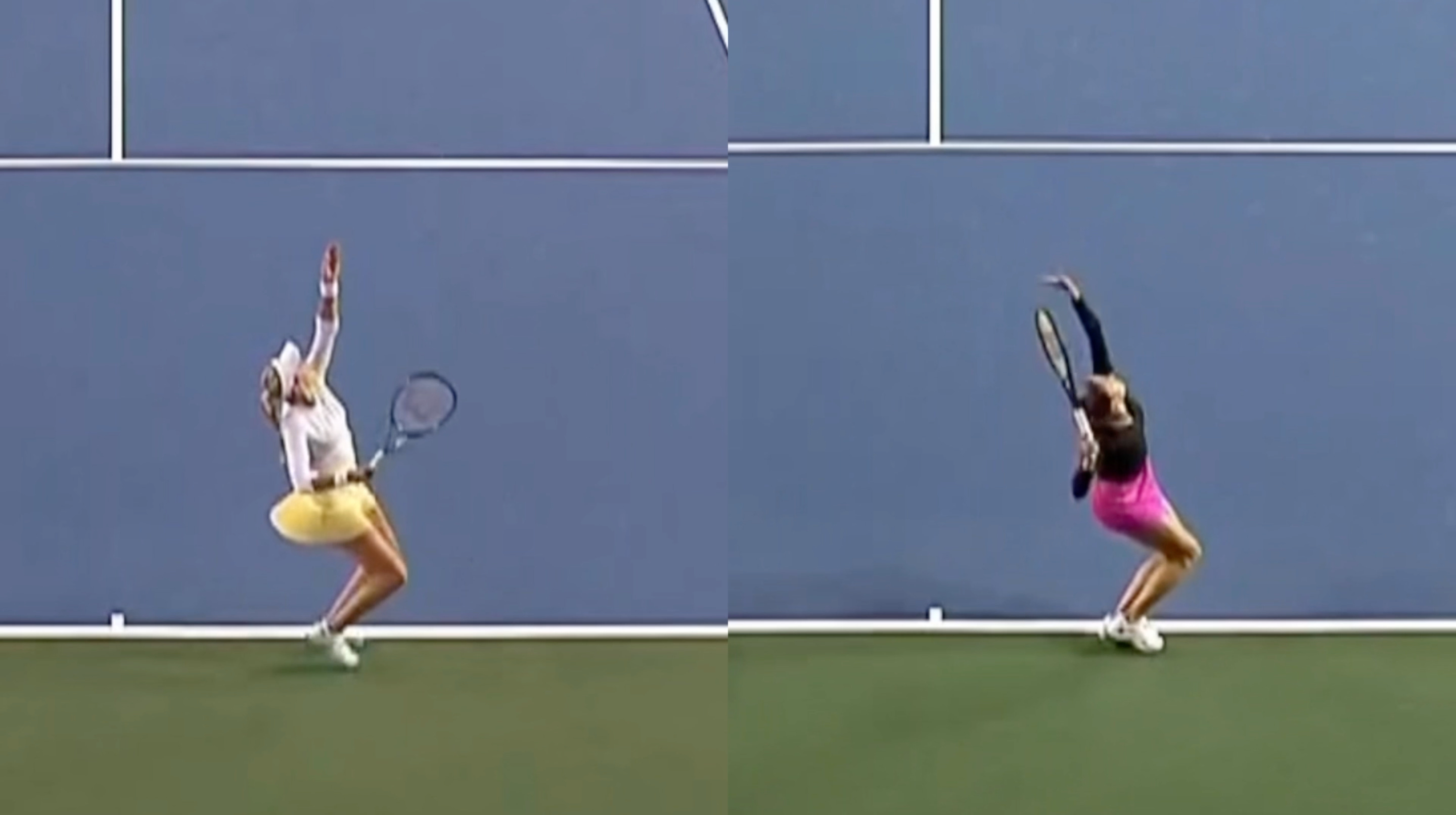
With no pause to the racket head’s movement and it coming over from the outside, there’s more room to accelerate through and more momentum. The leg drive could be better but, combined with her added height, it’s enough to give her the edge on the power serving-front.
I would love to layout the numerical differences but the serve speeds were nowhere to be seen from the broadcast angle.
What the toss also limits, however, is spot placement. With such focus on landing the heavy serve, timing it well enough to direct it into spots (particularly the wide spots over the higher parts of the net) is extremely difficult. So, the majority of serves from both in this match were close to the body. Unsurprisingly, then, there were just 3 aces in the match (2-1 in Katie’s favour), and 2 of them came in the final game.
It, of course, also has a negative impact on 1st serve %’s – Katie’s 56.6% average ranks 43rd & Marta’s 58% ranks 39th for 1Sin% out of the top 50 in the last 52 weeks (via tennisabstract). Therefore, it’s no surprise the two exchanged breaks multiple times in the opening set.
1st set
Katie was the first to break when Marta landed just 1/6 1st serves in the 3rd game. It highlighted the danger of Katie’s 2nd serve returning, as she had all week stepped around to blast FHs back to the feet of her serving victims.
However, Marta had, for the most part, landed her flat 1st serves well in the opening set to trouble Katie, who had yet to find her rhythm on return. That’s how she was able to win 79% of 1st serve points, despite not pushing the spots.
As for Katie’s serve, the standout aspect was her approach. She was persistent in continuing to go fairly big on 2nd serves all match, pushing closer to the sides, but with more slice. Marta, in comparison, tried to use the kick serve but scarcely got it away from the centre, and the cold, slow conditions made it difficult to ever get the ball to ride up on Katie, hence why she was such a force against them. Marta won just 33% of her 2nd serves in this set.
With that approach from Katie obviously comes risks, and risks that weren’t yet paying off, as she double faulted 6 times in the opener, including twice in the set-deciding break, and won just 39% of 2nd serve points.
That said, she was consistently getting favourable +1 shots behind both her 1st and 2nd serves. The key factor was that she had yet to get comfortable on the ball-striking and point construction front, which is why she ended up playing 19 more points on her serve than Marta did on hers.
Frustrated FHs
Away from the BH, which I’ll go into a little later, the FH had looked a little underpowered in the 1st set from Katie. Most likely feeling the tension of the occasion, as well as, at times, scoreboard pressure, she continued to strike it nicely with margin but not in a way that was overwhelming Marta by any means.
When it comes to the Brit’s technique, there’s not a lot to say but there’s a lot to love. You can see the simplicity of it in this replay angle below.
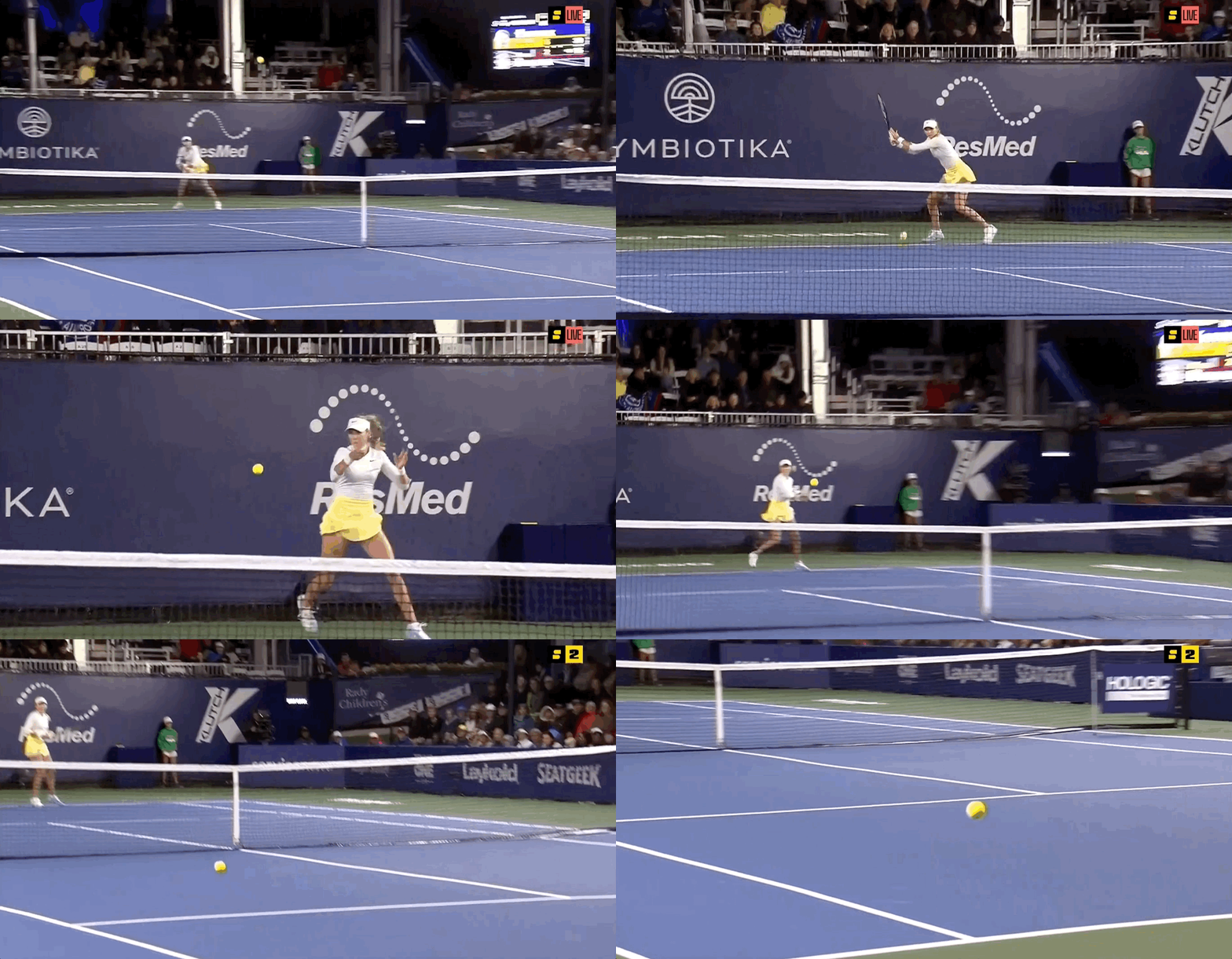
Starting the racket head upright allows for a gravity-assisted drop. With a neutral wrist, positioned above the elbow (all pictured below), it allows for a very easy kinetic chain.
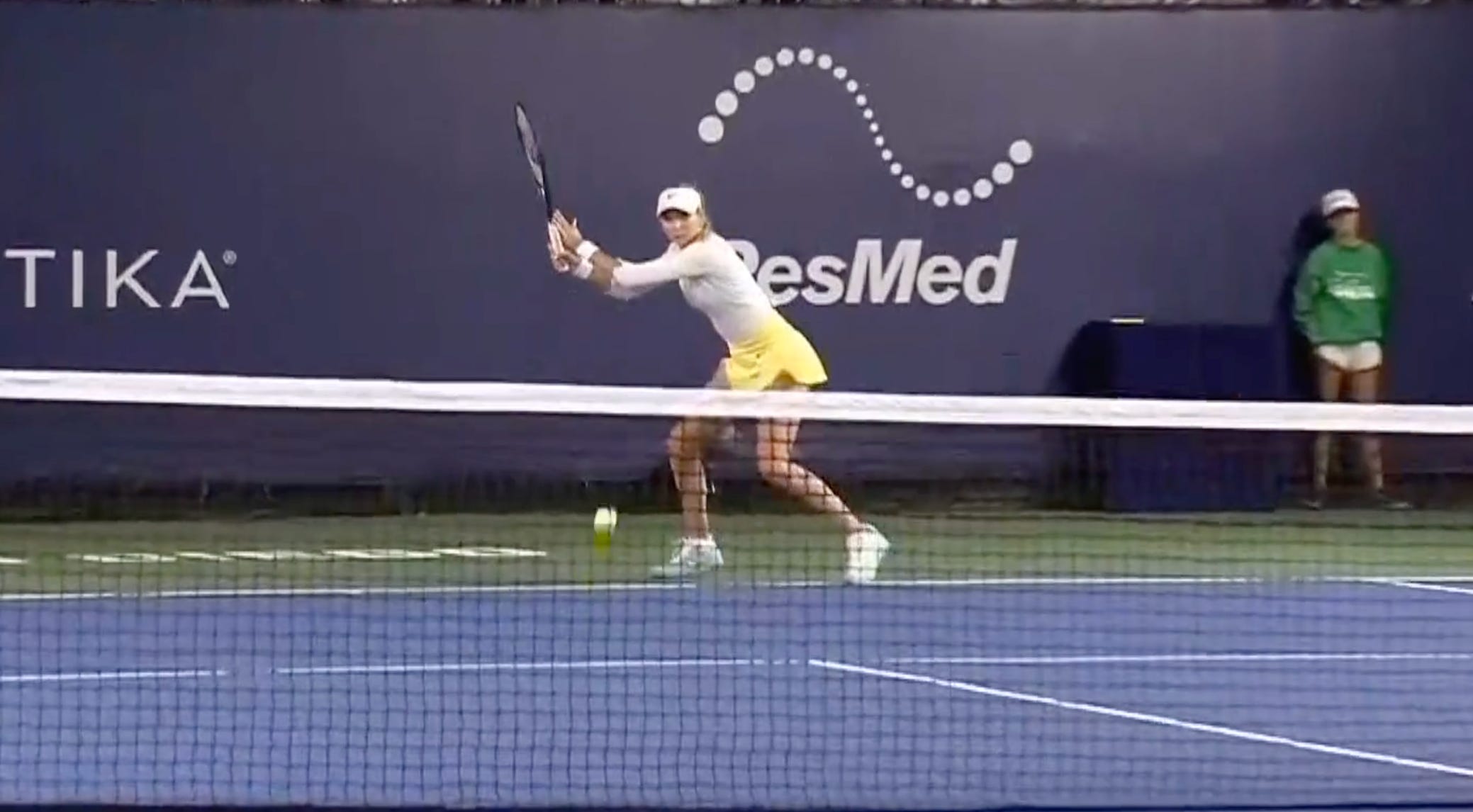
This is especially true because her take-back is so minimal, unlike her opponent’s. She doesn’t ‘break the plane’, she stays inside that line and accelerates almost instantly. Her semi-western grip offers that added bit of margin with more topspin being imparted on the ball, whilst her consistently-perfect spacing, coiling of the legs in her semi-open stances, and cuts over the ball on the follow-through allow her to flatten it out with ease.
Most important of all, then, is her timing. The simplicity of the above makes it so easy for her to attack the ball, whether she has time, is rushed, it’s low or it’s high. With such a compact stroke, you’d be a fool to try and go after that wing.
Marta’s FH, on the other hand, whilst boasting positive simplicity in some areas, is a lot less compact. As far as I can tell, she has the same (or at least a similar) grip setup and also begins with a high racket tilt, but using an extended wrist (cocked back to promote a better racket head position which can help produce lag) that brings her closer to the full 90º tilt.
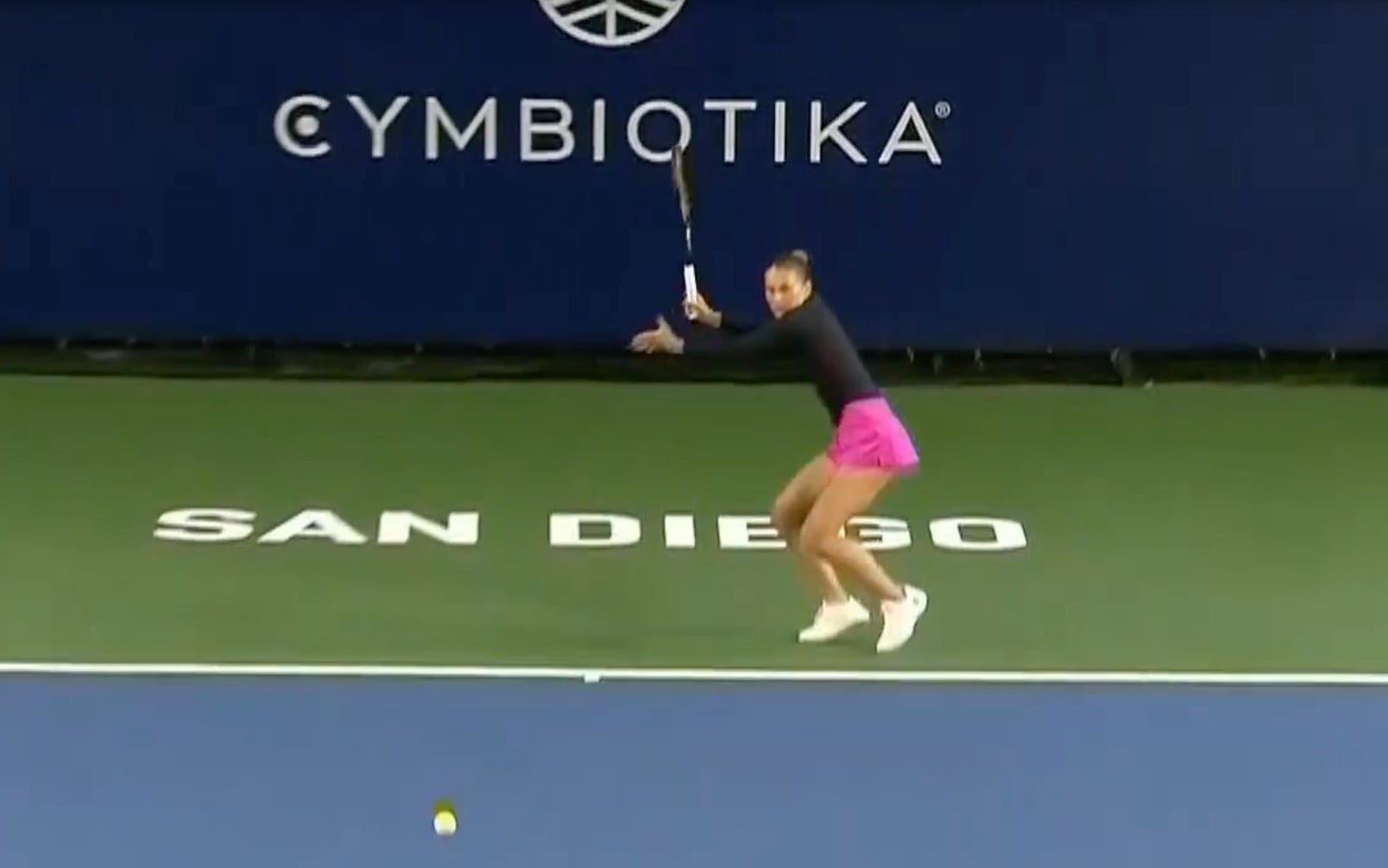
The lack of compactness comes from the big take-back. When she has time, you can see in full how she breaks the plane by how the racket angles back past her own back.
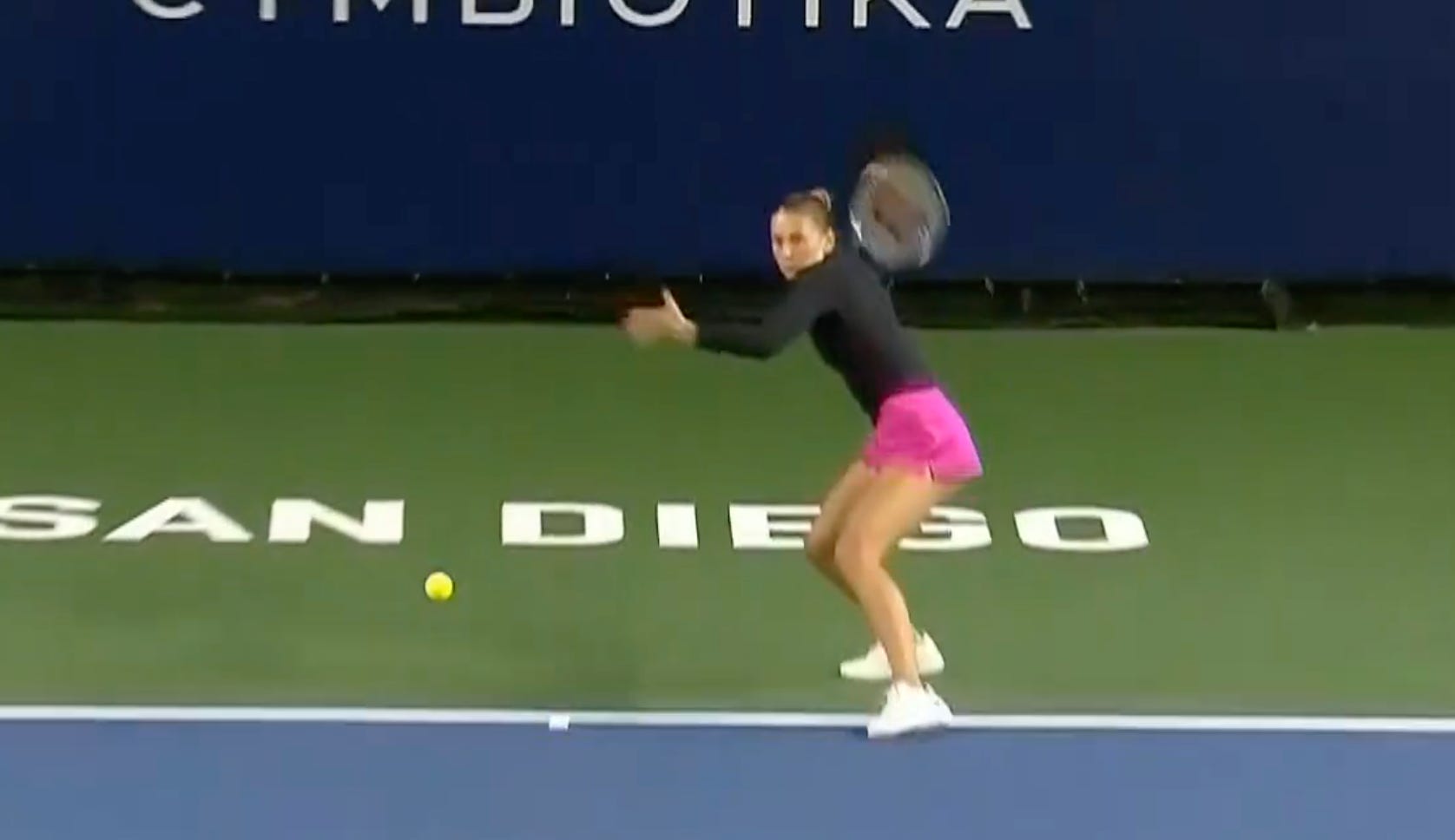
A big take-back can allow for a more powerful swing through the ball, but it can also be a crutch in certain situations. Since the extra time taken needs to be accounted for, the footing has to be well-timed and placed in order to hit through the ball comfortably.
So, for Marta, and many others with similar setups, she can struggle against shorter and angled balls as planting forwards and/or wide is difficult to do whilst maintaining balance through a shot. If it comes through low, as well, the amount of space the racket needs to move through makes it hard to get up from under to apply topspin, meaning Marta has to search for that shape and spin at contact with a turn of the racket (typically using a windscreen wiper-like motion).
See how it also pigeonholes the angles available, as the off-balance weight transfer and flat swing through makes it incredibly difficult to not take the ball exclusively cross court.
However, Marta does reduce the size of her swing adequately when made to move and/or is rushed. She doesn’t break the plane in those instances and uses a more compact swing to make contact with the ball in time. She does this with very lateral movement and uses mogul shifts when meeting the ball, which work fine when it comes to defending consistently, but these open stance movements combined with the amount of spin to her shots makes it hard for her to counterpunch with much force.
Against Katie, in particular – who has an easy time creating room for FHs, and who flattens out the ball in both directions with great margin and pace – it left Marta in a bit of a cage. And, when the pace is there, Marta doesn’t have the leverage or the room from that open stance to handle it.
A massive 49.4% (87/176) of Katie’s FHs were run-around FHs, compared to Marta’s 16.6% (24/145). Katie also hit upwards of 60% of her groundstrokes as FHs, both on points behind serve and points behind the return.
Yet, thanks to Katie’s predictable patterns in the 1st set, it is this that helped Marta to clinch it.
Despite her serve and groundstrokes constantly creating chances to press Marta against a high returning ball, Katie’s corner to corner, one-paced pressing meant Marta could cover the court in, effectively, a horizontal line and do so with easy anticipation.
What didn’t help Katie in situations like these, where her strike wasn’t enough to overwhelm Marta, were the misjudgements when it came to closing at net. She had strikes big enough to come in behind, but she would come in against the BH, and wouldn’t act on obvious opportunities being presented by the floated nature of Marta’s defensive FHs.
Marta’s BH is the more solid of the two wings and she does a better job of absorbing pace, countering from deep and flattening it out on that side, which made Katie’s narrow approaches ones she could pick off with passing combinations.
2nd set
Although Katie had started the set still focusing a little too much on Marta’s BH, she eventually got the message and started to not only exploit the FH, but also play with more variation and patience.
As you can see in this pressure point, Katie shows great patience to reset mid-rally and calm her shot selection down in the ad court trade. She adds more loop to her FH for better margins, and, finally, does an excellent job of creating the space to flatten out the inside-in on the retreat, which jams up Marta’s open stance shift and rushes her swing, resulting in a forced error.
There were also more direct examples like these which picked Marta’s FH apart.
Here, she rushes the FH twice to get the weaker response and uses the time she has to manipulate the ball through the angle with placement now prioritised over power. Then, by pausing in that semi-open stance, she’s able to disguise her selection and pick her lane for a clean winner.
Katie continued to sprinkle in more and more of these short balls into the FH, whilst also pressing with a lot more vigour as losing the 1st set had seemingly relaxed her.
Returns & +1s
What’s important to note about that clip, also, is the pressure from the 1st serve return.
Now we were seeing a much more proactive version of Katie on the return. She can go through spells in matches where she chooses not to lunge forwards to meet 1st serves, but when she does, and does so successfully, she is a nightmare to deal with.
What she does in that previous clip, which is almost Djoković and Sinner-like, is move to intercept and use the pace of the serve. Here’s that part of the clip isolated.
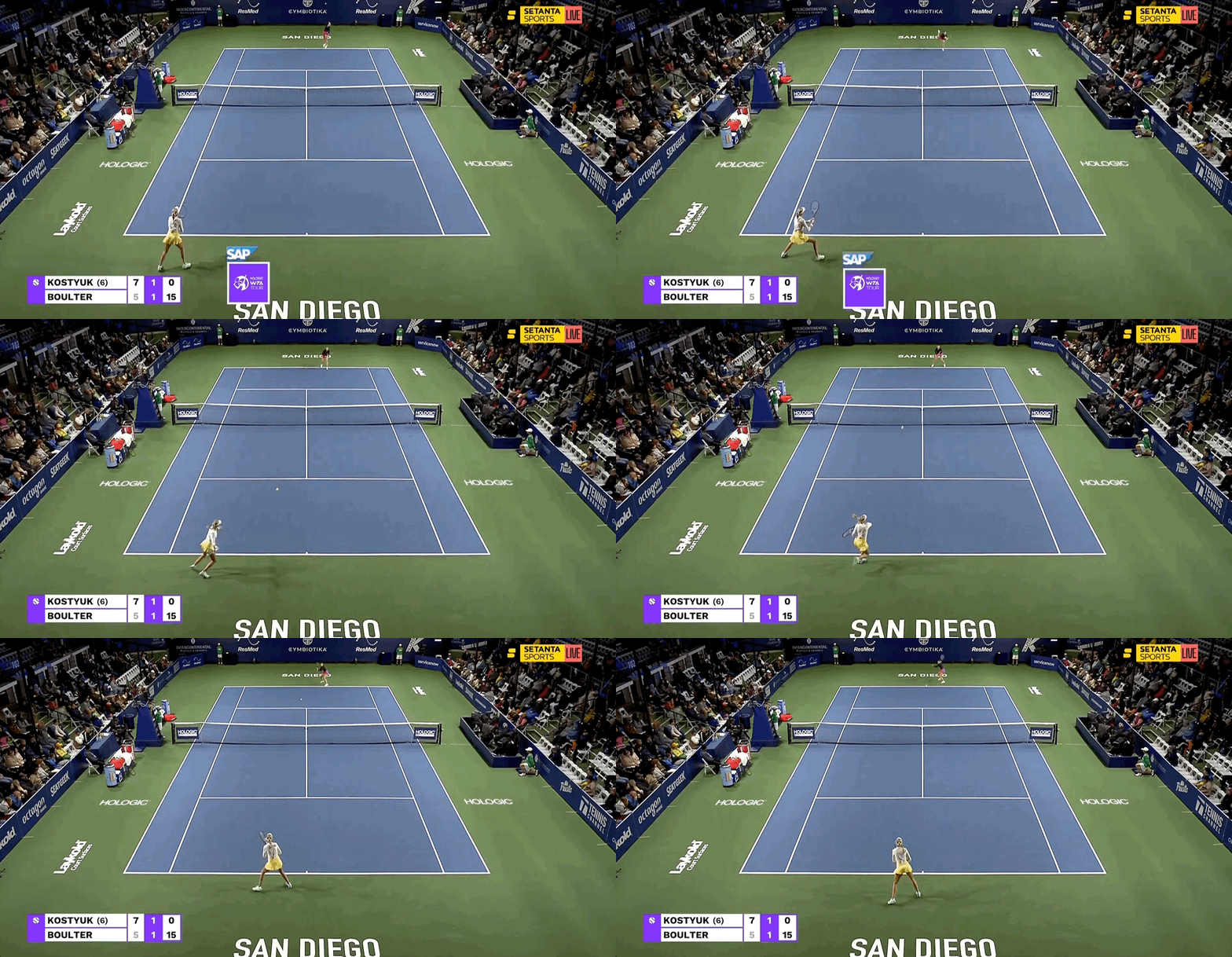
The important steps are:
split-step forwards to initiate drive
landing on the balls of your feet to allow you to easily pivot and launch towards either side
launching into the ball diagonally (not laterally) so there’s forward force going into contact
transferring your weight this way into the ball by planting the far-sided leg across, meaning you suspend yourself in the air through contact (this also holds open the space to the side so you have easy room to swing through)
And, if you want proof that it’s Sinner-esque, see below:
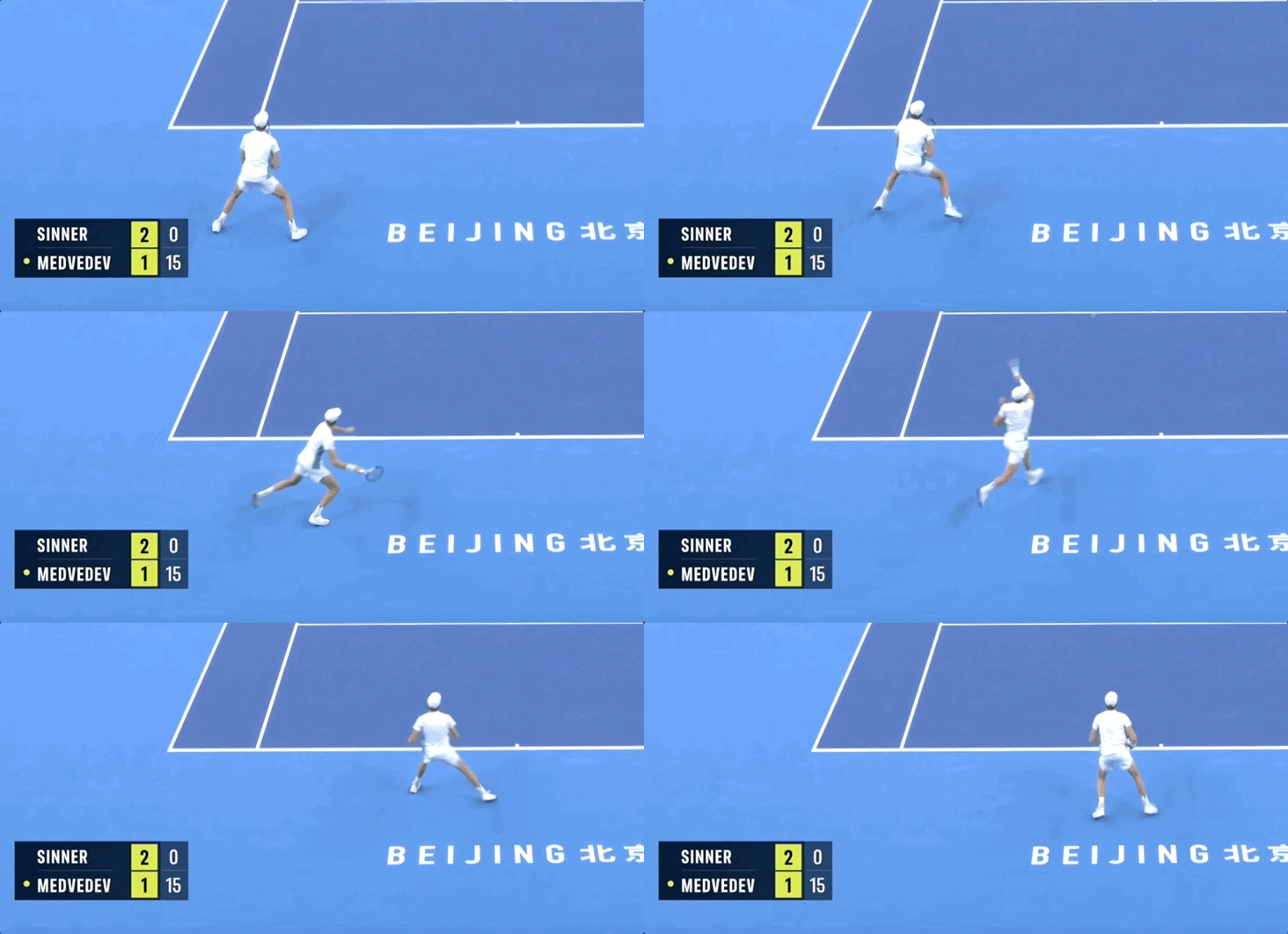
This sort of approach can be significant for Katie because her BH doesn’t always bear the brunt of a serve’s pace too well, but with forward momentum she’s able to be steadier behind it.
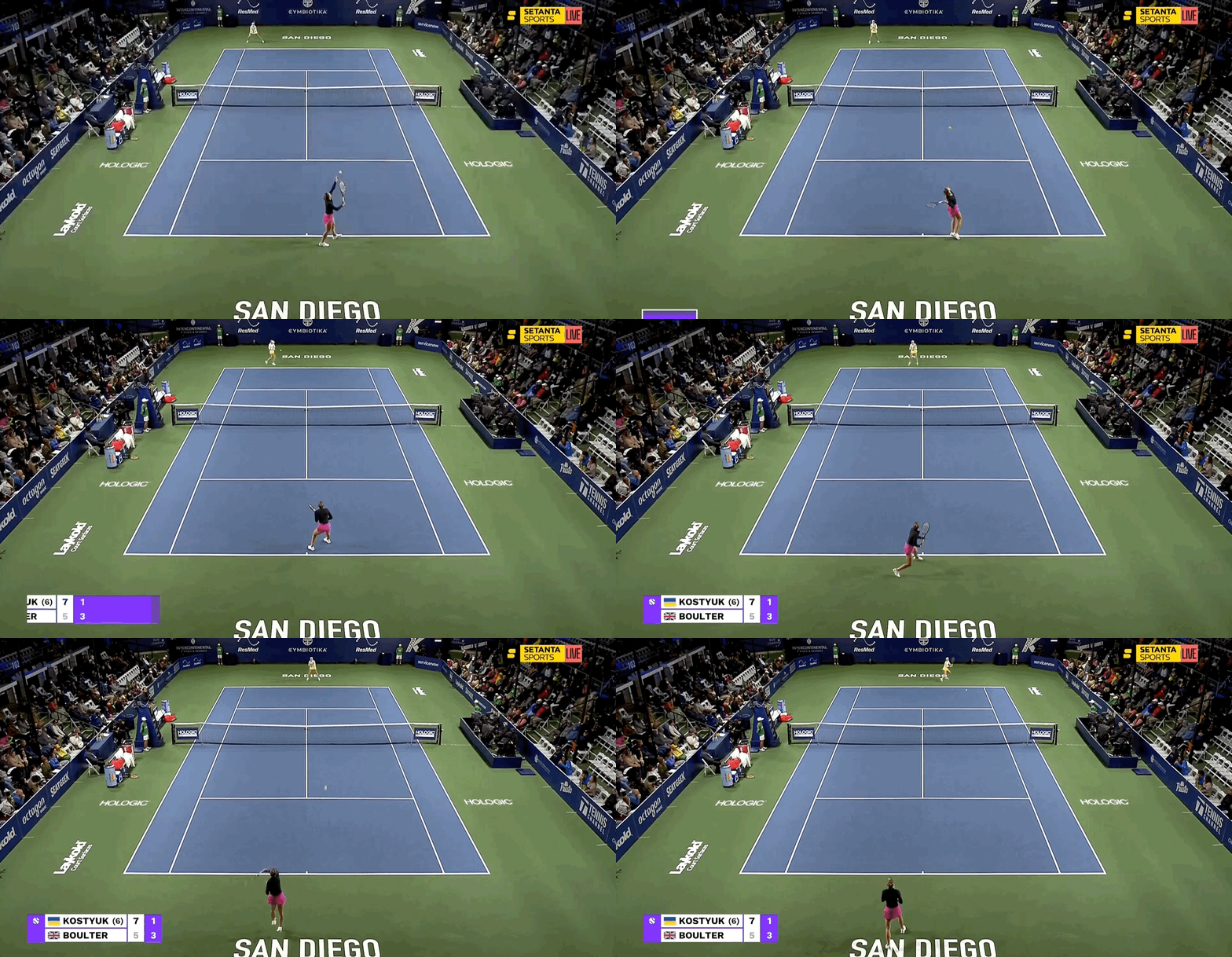
That renewed trust in her timing only spelled problems for Marta. Katie was getting everything back this set, even when she wasn’t lunging into 1st serves, and she was feeding Marta some difficult +1s to deal with in the process.
Some of her BH returns versus body serves were finding their ways into Marta’s FH corner, and were exploiting the issues I touched on earlier.
Marta didn’t have a concrete response. Katie rarely strayed from playing the %’s by putting it back to feet, and it always meant Marta was retreating on her +1s to buy her swing time. But, since she couldn’t then get over the ball, she was having to loop it up to Katie’s BH corner just to hang in the point.
Inevitably, this level of return pressure took its toll on Marta’s own approach. Her 1st serve % actually rose through the sets – from 56% to 61% to 71% – but only as a measure of caution. Unsurprisingly, the win % dropped from 79% to 43% & 49%.
This 1st serve kicker attempt, that is swiftly dispatched by Katie’s BH here, is a good example of such:
On the flip side, it was a very different story. Marta was one of many in San Diego that week who failed to really get at Katie on return, and Katie’s aforementioned persistence with the heavy slider 2nd serves was beginning to reap its rewards.
As was protocol for Katie, she looked towards the FH more often than not, as that side had a bit less control over the ball than the BH for Marta. Whilst she would mix in 1st serves into the BH, with the T on the deuce being a favoured spot generally, Katie only hit 4/36 (11.1%) 2nd serves into the BH half of either service box across the entire match.
With good pace on sliced serves that slid away from Marta, Katie continued to get favourable +1s, whilst Marta came up short in her solutions.
There was always a bit of a contrast in how Marta moved for her returns as she shifted laterally, pretty much exclusively. With the relatively big take-backs, spin in her swing, and the pace she was facing, she scarcely managed to take full control of what was delivered to her.
Marta seemed to try a whole host of different approaches since the serving patterns were fairly predictable. Without enough forward momentum and the pace of the serve helping to rush the FH, it was always very difficult to throw Katie’s pace back at her. So, from her static position, Marta typically offered up a lot of loop off that FH side, which made it easy for Katie to step around and get her FH into play.
The difference in +1 striking under pressure is what made it so hard for Marta to get results, either way. Katie had no problems holding her position and using her compact stroke to pick up the ball and give it back with interest, in ways that, at the very least, always kept her at neutral.
With that being a no-go, the main goal was to get it into Katie’s BH for +1s. This was easier said than done. Marta’s BH return got better depth to help force these but that wing wasn’t a big target of Katie’s serve, so then it was about shortening the follow-through to help guide the ball into that side on the FH.
Marta did this best off the deuce side when she could redirect it down the line, however, this approach didn’t offer up too much pace to help overwhelm Katie’s BH.
The reward for finding the BH on the +1 diminished as the match went on, however, which takes us onto…
Backhands
Katie’s setup
Saving perhaps the most significant narrative point until last, the BH battle was always going to be massive for Katie here, as it is in any big match.
There’s a good mini breakdown from a little while back of Katie’s swing, here, but I’ll break it below, too.
The swing itself for Katie is almost a diamond in the rough.
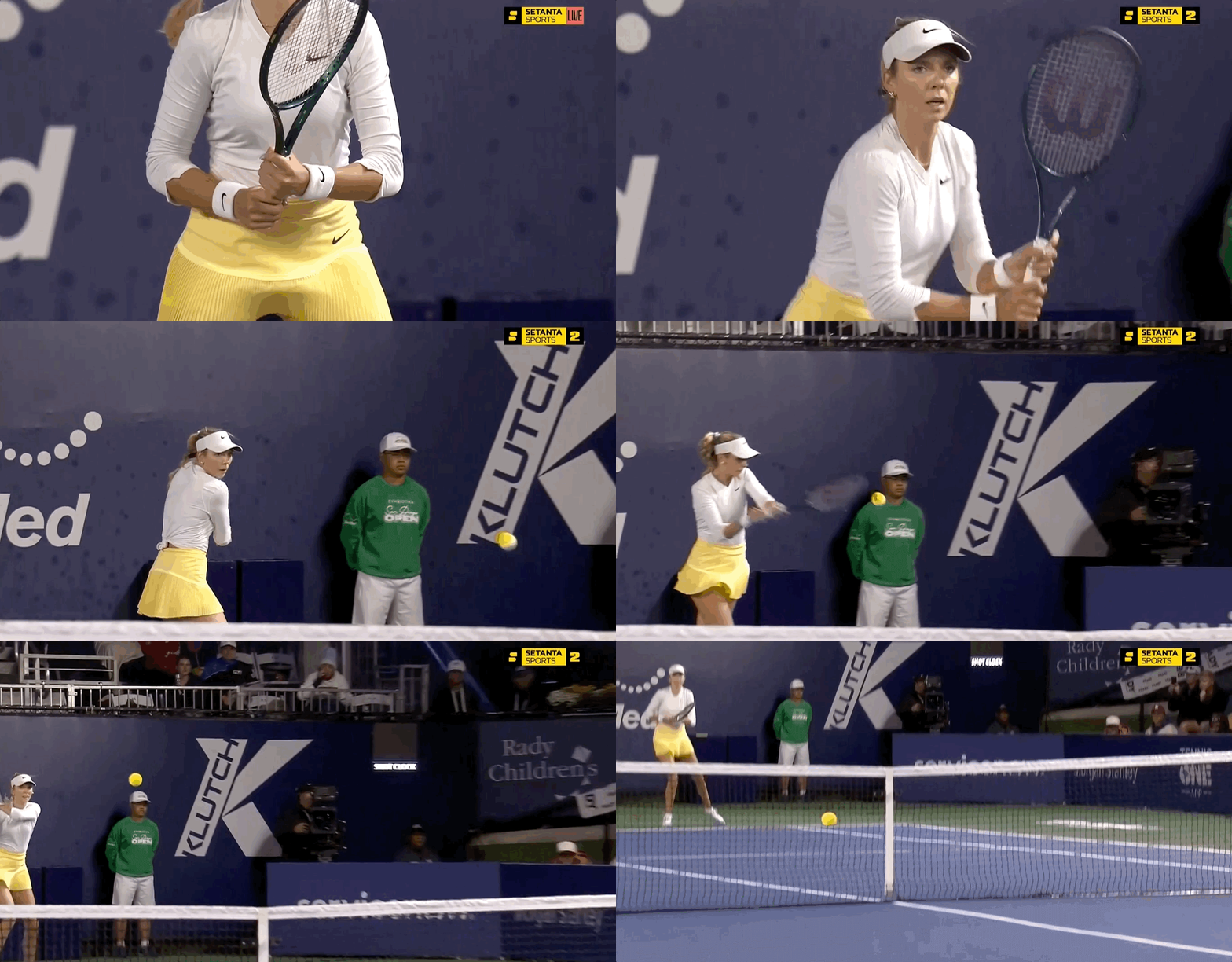
Katie has a pretty standard setup, with a continental right-hand grip and an eastern left-hand grip. Backing up that flat, open-faced eastern grip is the “split grip”, i.e. her hands are spaced apart, with the non-dominant hand choking up the racket.
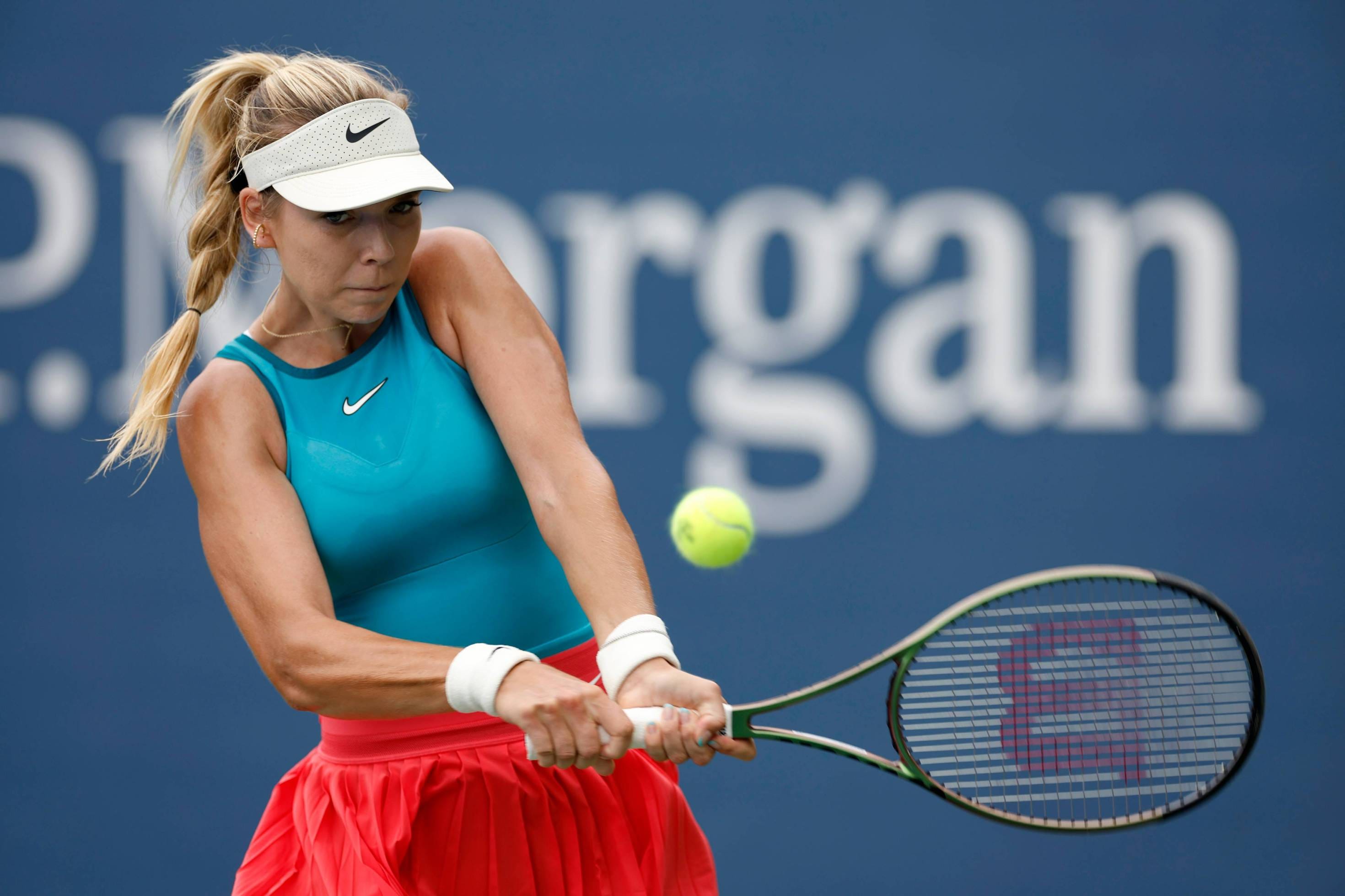
The likes of Daniil Medvedev, Karen Khachanov and Cam Norrie also do this. It’s typically an aid when it comes to controlling the ball as you have a better feel for the head of the racket. It’s also then useful for feel shots, like hooked passes. The limitations relate to power generation and also reach, as you’re holding the racket closer in.
The first thing Katie does really well is execute the unit turn to get the racket back inside the line (of the ball). She does this whilst holding a high ‘power position’ (same application as the aforementioned FH racket tilt).
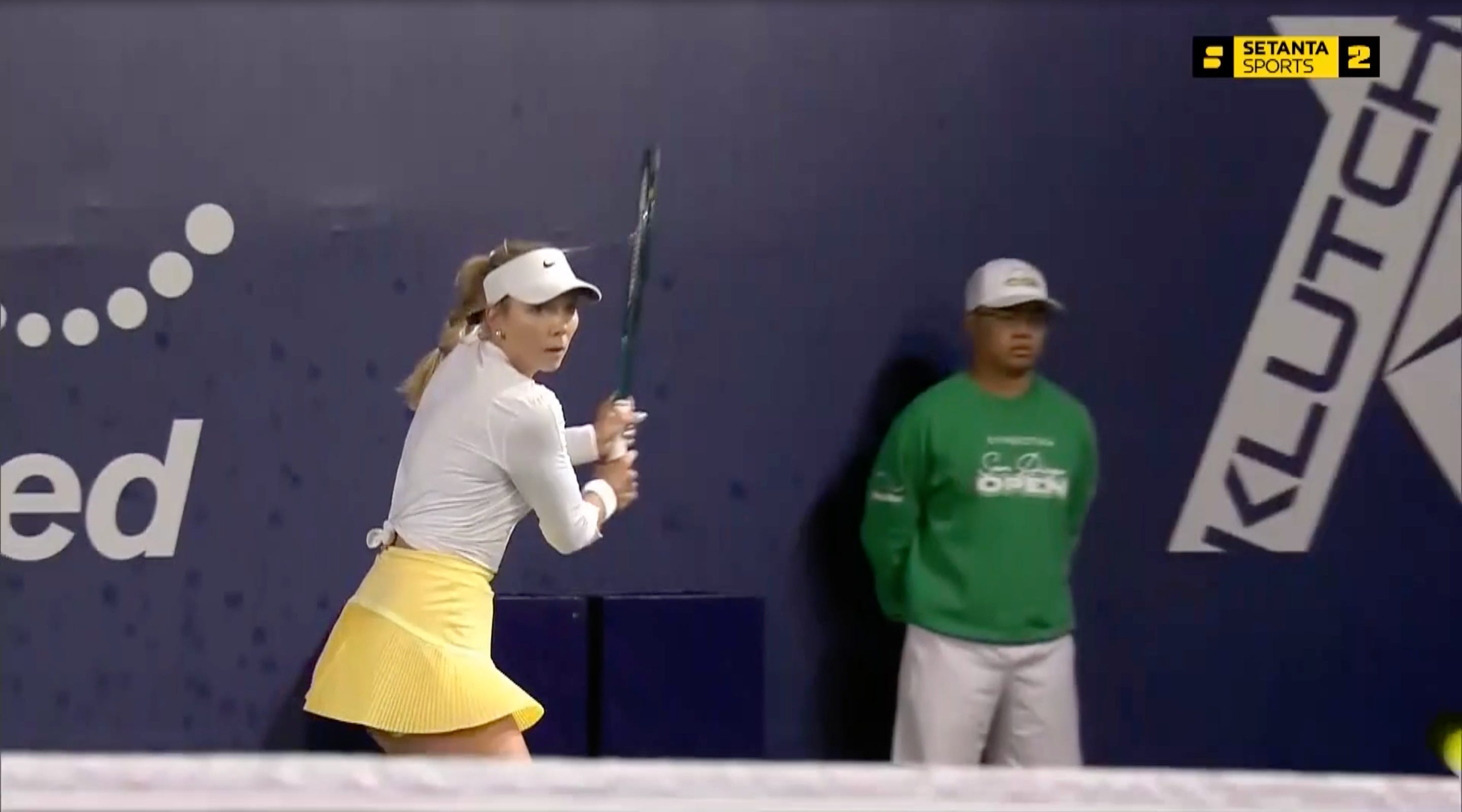
Next is the racket drop, aided by that power position, which allows for an easy kinetic chain.
She relaxes the wrists well to let it drop into ‘the slot’ (down by her knees) whilst breaking the plane, which is more advisable on the BH because power-generation is more difficult. Still, her swing isn’t as big as Marta’s, as you’ll see.
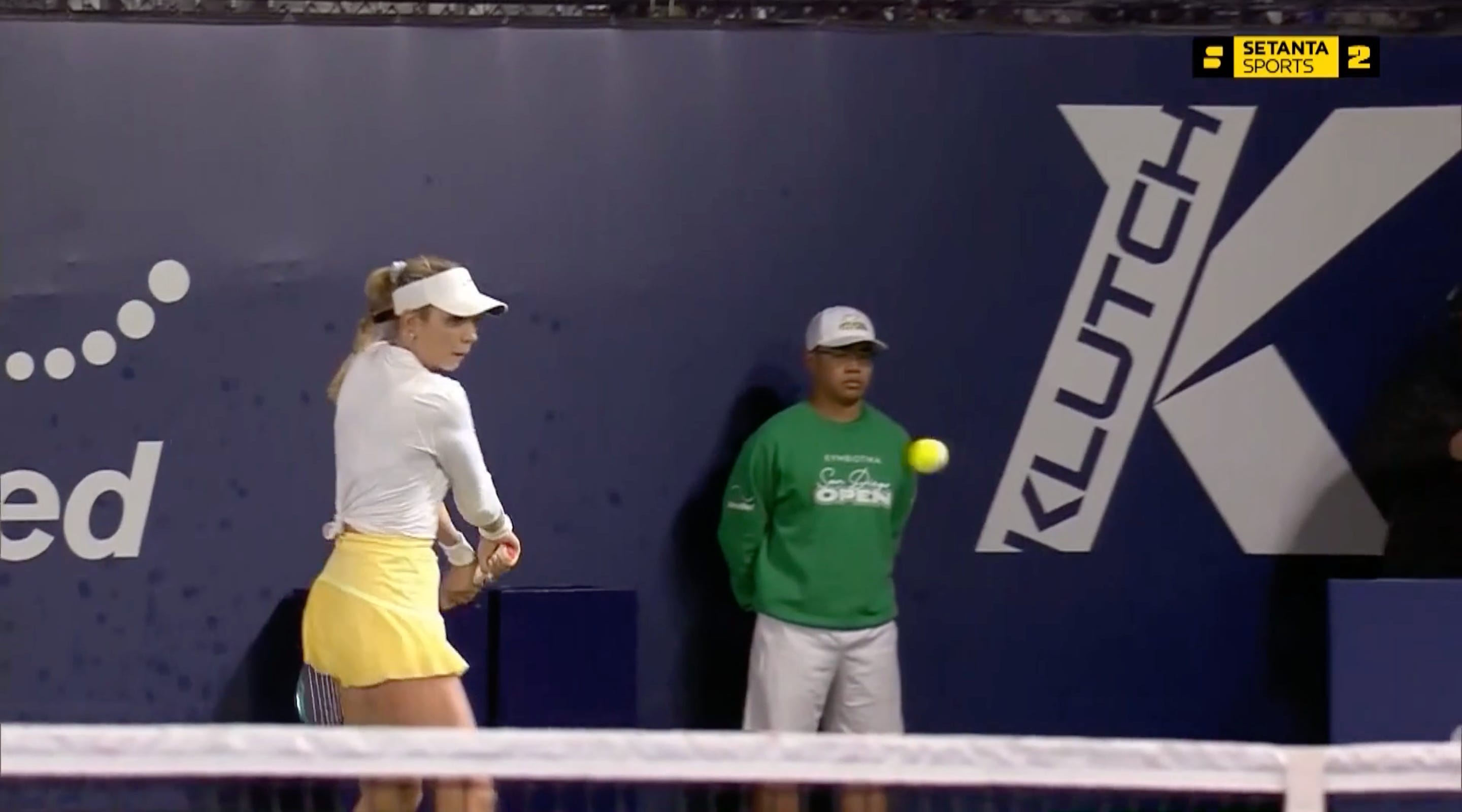
The rounded motion is great for easy acceleration and is also key to accessing the outside of the ball (therefore greater access to short angles). Players who hold their rackets out to the side (outside of the line) struggle to do this because they don’t then have enough time to get the racket back and to then extend outwards fully.
Also important to note, here, is that she doesn’t close up the racket face on the way through. Players point the strings down on their way up to the ball to impart topspin, but Katie instead uses a very flat swing path, similar to Murray.
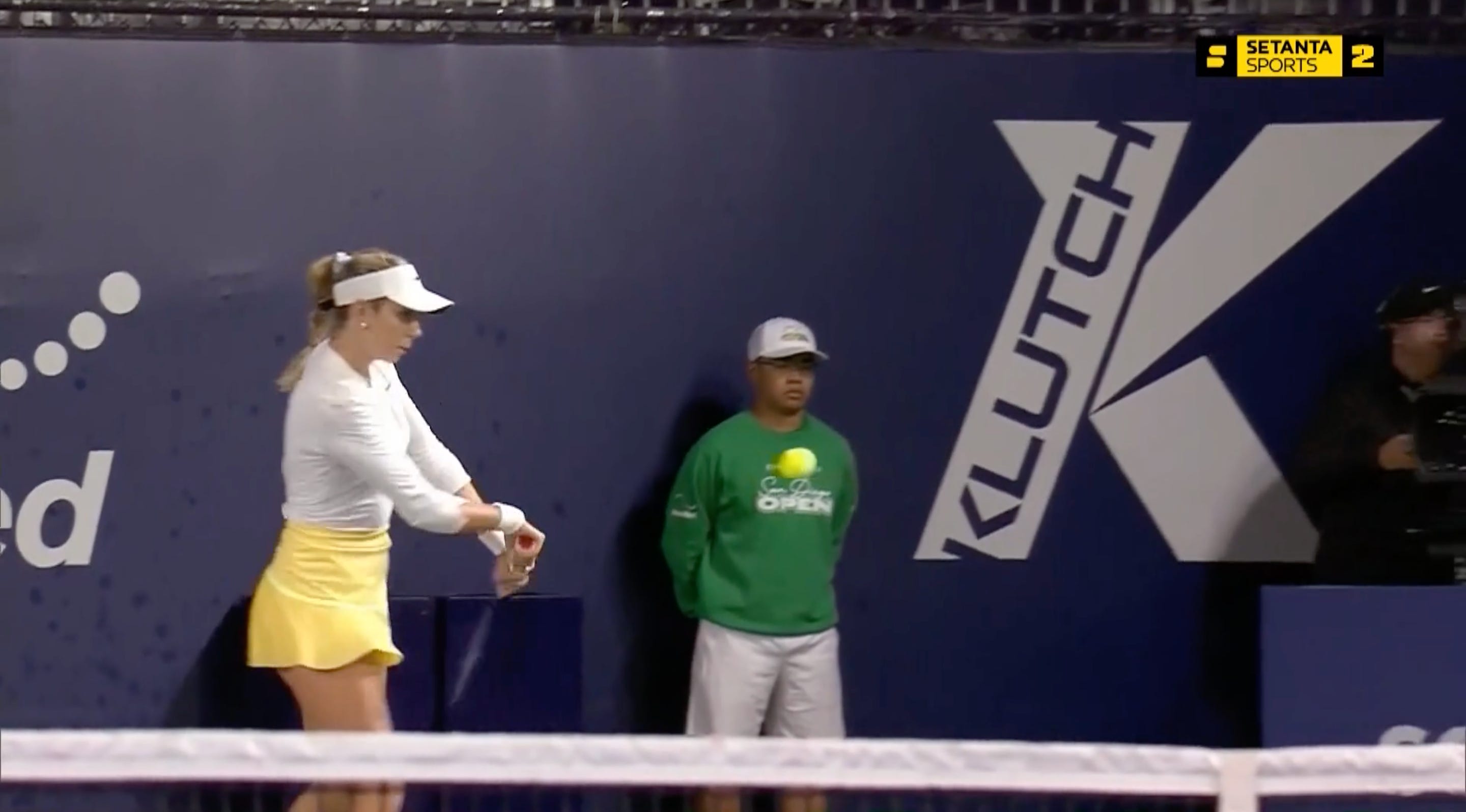
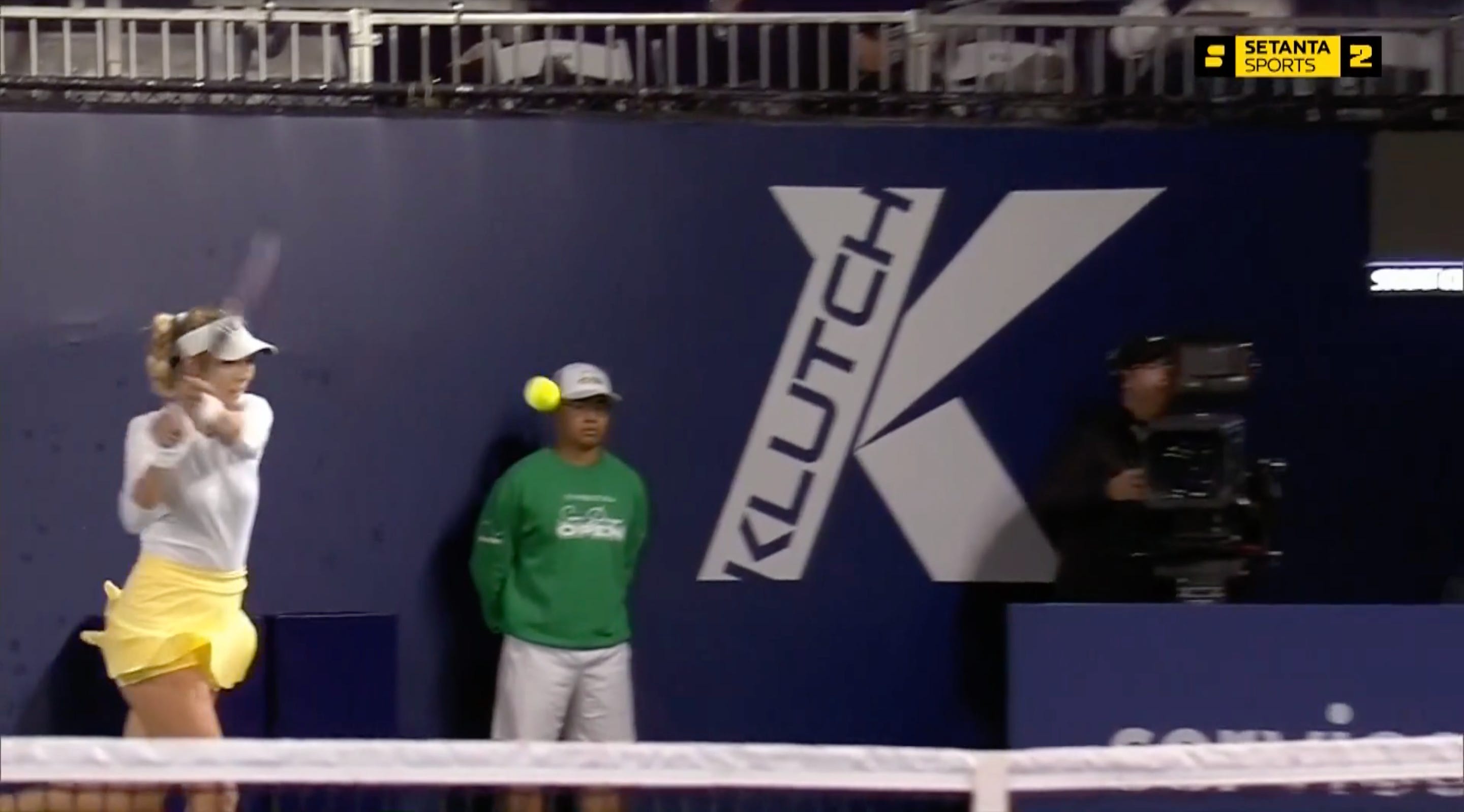
What Katie also typically does (if you can tell from the blurry image below) is lock her wrists. This way she maintains that flat path and keeps her racket face open for longer, as opposed to players who use more left-handed feel to roll their racket, meaning the strings face down afterwards (see, again: that Murray video). This can be ideal for down the line shots, for instance, as you have a greater amount of time to find the ball with the open face.
So, what’s the hitch? Well, it’s not in the swing. It’s in her footwork.
Katie has a difficult time handling direct and heavy pressure, despite ticking so many technical boxes because she doesn’t afford herself a secure base. Additionally, she restricts herself from finding the outside of the ball because she so often doesn’t plant her right leg across, and when she does, she often pulls back in off it rather than following through.
This can lead to forced errors just as easily as it can lead to BHs that waste attacking opportunities and reset points back to neutral.
Katie, here, like Marta on her FH, mogul shifts with the BH. This can be perfectly ok, at times, but can make it harder to comfortably reach the outside of the ball, particularly with her limited reach when she plants the outside leg inside the line of the ball, and laterally so, rather than outside on the full stretch/slide, possibly angled backwards.
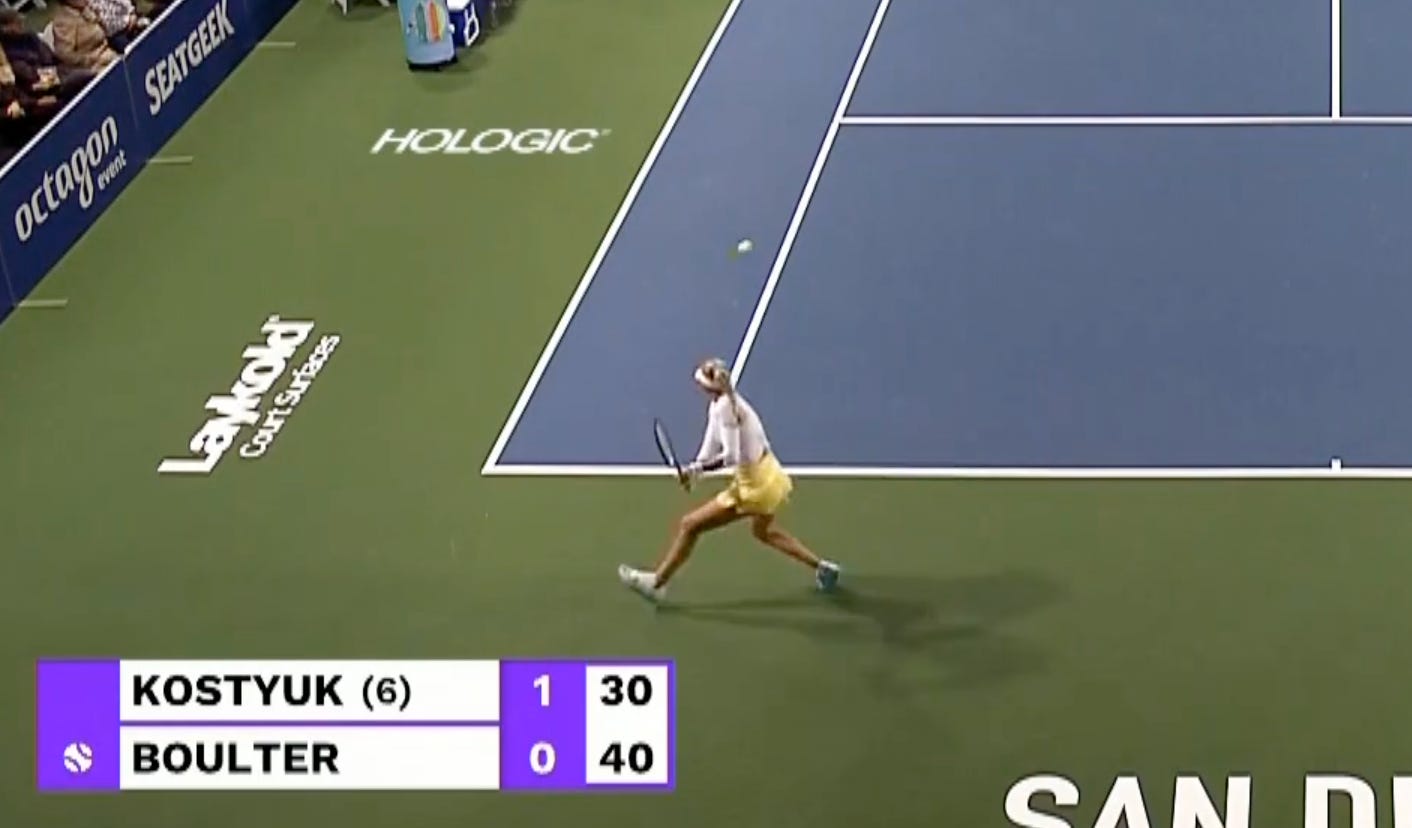
As for the follow-up, whilst Katie does move to plant her right leg forwards, she doesn’t push too far and nevertheless holds a very narrow base. Again, with the slightly lesser reach due to the grip, it only exacerbates the lack of access to the outside of the ball.
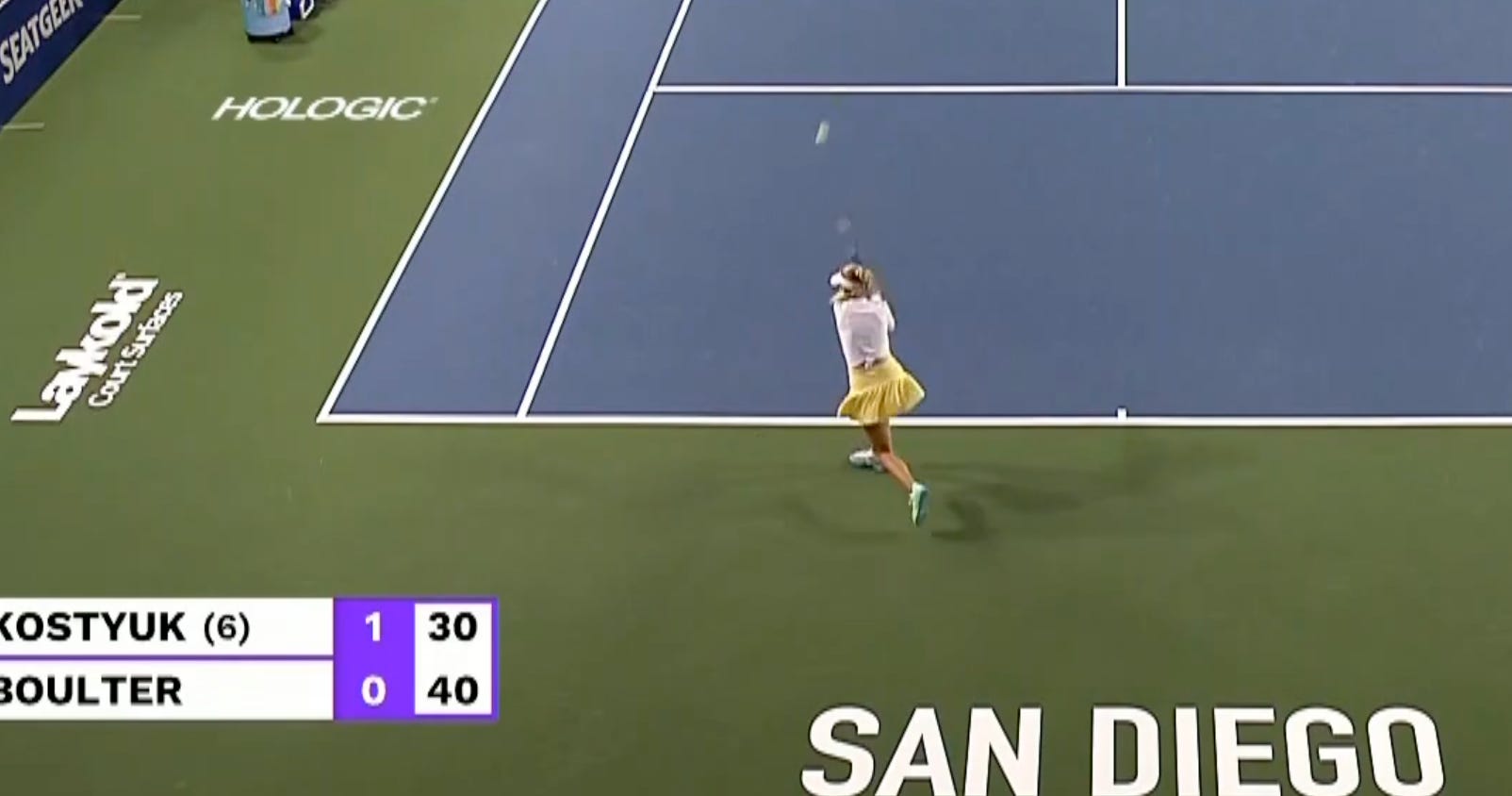
When she is overpowered in these positions, it’s because her feet are planted parallel to one another and therefore they don’t provide enough backing to the swing that’s isolated out to the side.
In this case, without the aid of topspin for greater margin, and the fact she doesn’t plant far forwards enough to get further down and/or up to the ball’s level, it’s easy to miss long as she pulls up from the swing.
The only times she gets away with such a narrow, detached base is when attacking in behind and down the line, as her swing effectively uses the pace coming in from a wide angle to drive it back without the need for weight transfer.
Another good example came when Marta exploited this much more aggressively with the net close because she knew Katie wouldn’t find the space either side to pass her:
The first retreat and BH off the back leg is understandable, but Katie’s reluctance to intercept the path of the ball by stepping up and planting across with the right leg versus Marta’s approach means she’s pigeonholed her angles to just the middle.
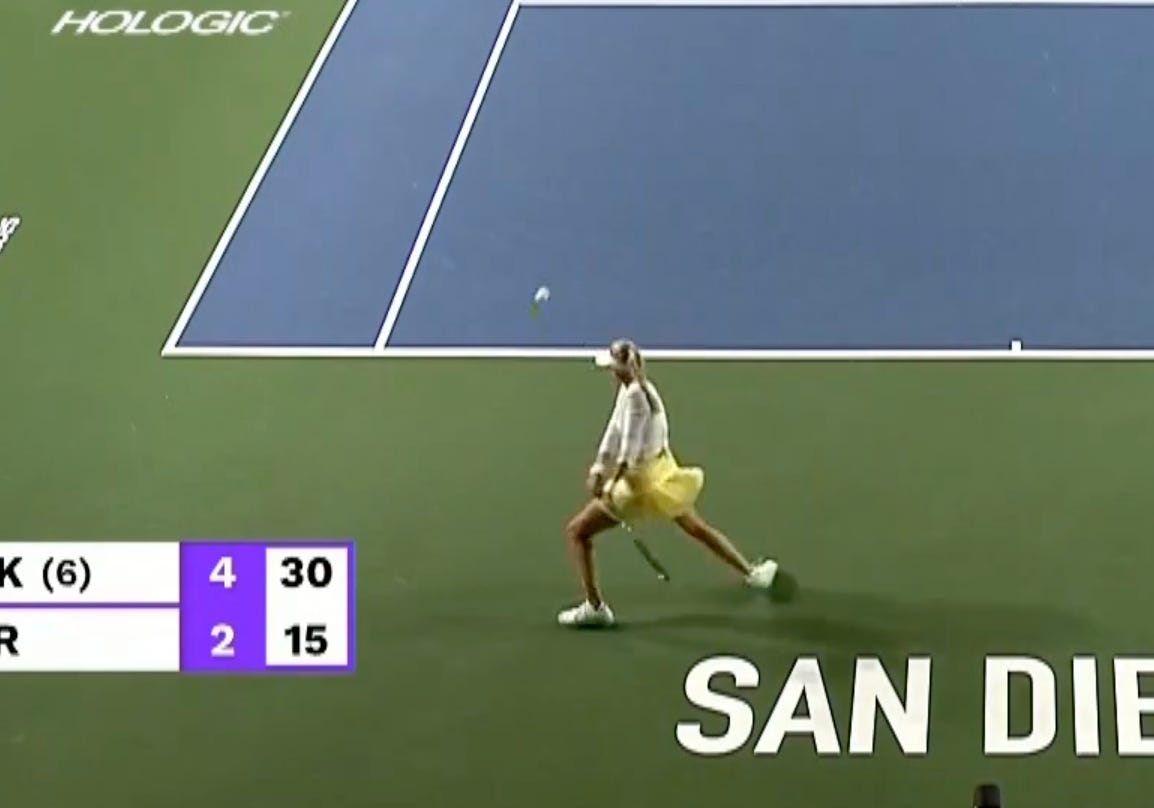
The mogul shift, here, even makes it difficult to be balanced enough to take it down the line instead of finding the outside of the ball to go cross court. The result is an easy put-away volley.
Marta pressed the BH again in the very next point to force an error.
The very lateral mogul shift makes it very difficult to secure herself against the pace and depth of the ball, let alone get around the outside of it.
Compare this to Marta’s stance in the earlier clip, where she planted diagonally back to give herself time to find the outside and hit the short angle.
In another instance of Katie’s right leg planting restricting her, she gets bossed around in this extended trade.
For the +1 shot, she actually has time to take the leg back in and then plant it forwards to transfer her weight through the ball, but she instead pulls it in and limits herself to hitting through the middle. Even if she wanted to hold this narrow stance to play an off-BH (inside-out), she couldn’t because the right leg would still need to hold firm in front.
She does similar for her +2 shot – pulling up from a very narrow base. Because that ball comes in at a nice pace close to her body, she is able to use the swing well to drive the ball harder, but is then caught out when Marta presses her with the next.
Once again, she could plant forwards, with a left foot-right foot 2-step shift across, but instead does the reverse and forces herself to awkwardly pick the ball up with a jammed body position and no weight transferral. Marta recognises this well and catches her out with the dropshot.
Even here:
There’s a lack of commitment to the plant, as she pulls up and inwards right away, therefore not getting right down to the level of the ball and thus losing control of a low % shot through a short avenue.
Further examples like this, below, highlight opportunities for her to get on top of the ball more to be able to drive it into space when her opponent’s out of position, but because she plants so close into her body, she allows the ball to rise and fails to put her weight through the shot. Then play is effectively reset.
With all that said, and these things continuing to appear in matches I’ve seen from Katie this year, she did progress as the match went on.
Marta’s setup
Marta didn’t have the raw power to unsettle her consistently, so it wasn’t as big a factor as she would’ve liked it to be. With Marta mostly testing the trade itself, she wasn’t getting too much success. That much is, however, a credit to how solidly and with how much margin Katie has hit her BHs in these conditions, where the extra bounce and slower pace has aided her.
In fact, the flat zip Katie was hitting quite short and centrally, as a result of planting short, was exposing a weak point of Marta’s BH – her movement & balance when getting up to short balls.
In terms of her general setup, she’s very similar to Katie, in terms of how she grips the racket.
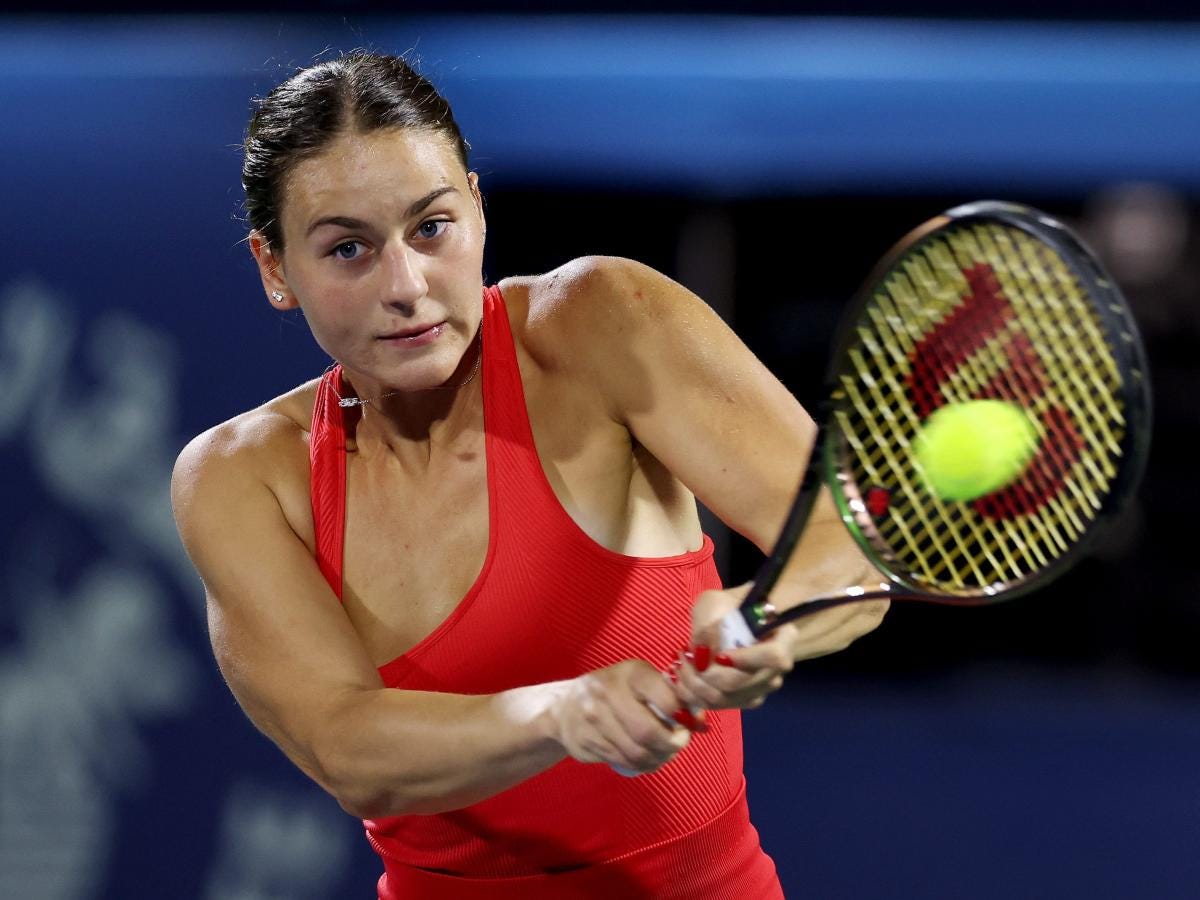
She also does a good job of getting back inside the line of the ball, having that power position, and everything else. She also uses quite a flat swing path. The key difference is that she has, again, a much bigger take-back.
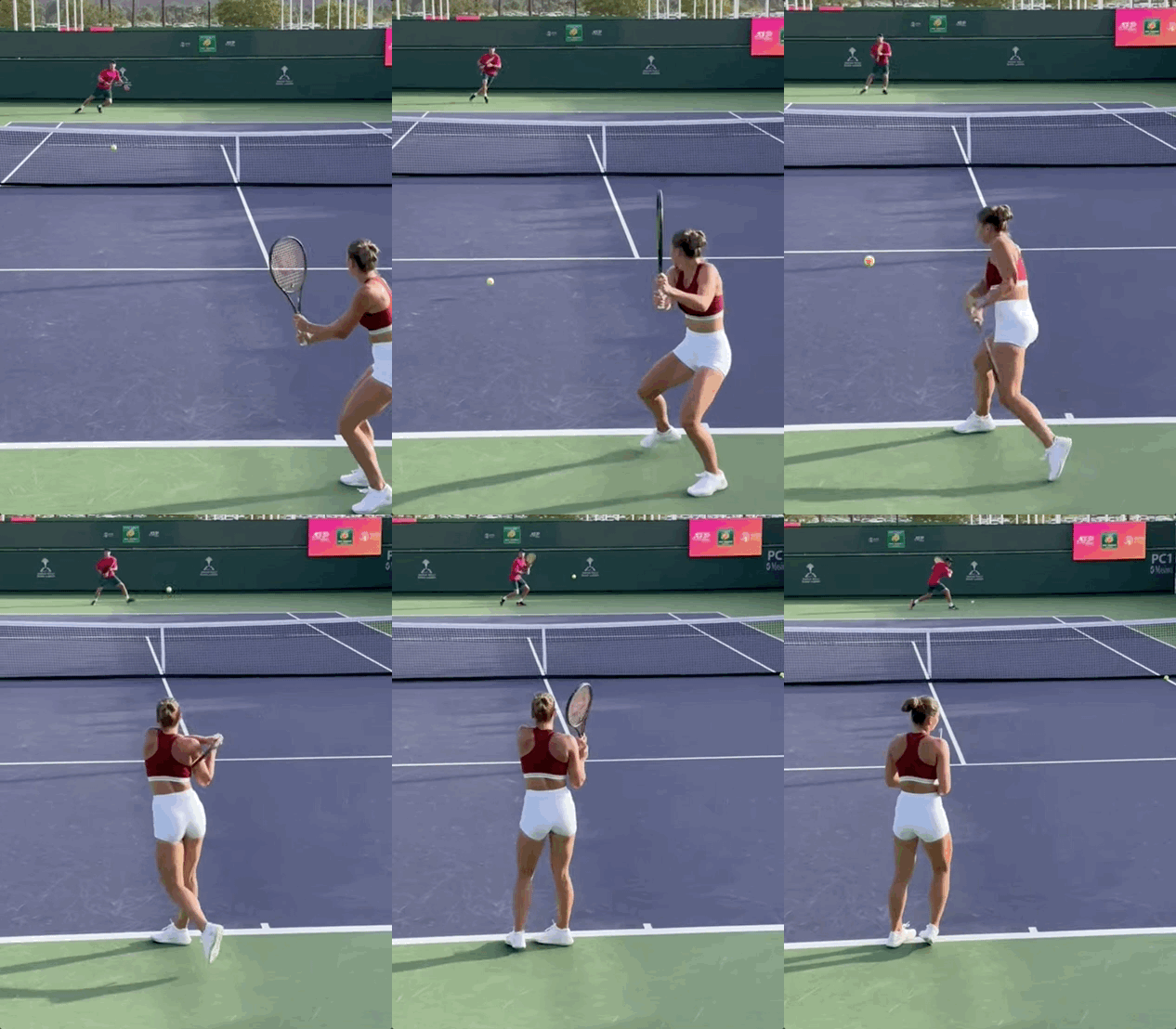
You may also see that she finishes with the strings facing down, as she uses her left hand to dictate the shape of the ball more often.
Similar to her issues with getting up to short FHs, though, Marta looked very unsettled when she was brought forwards from her line of movement.
She, like Katie, moves up to the ball with a very side-on stance and her feet parallel, making it hard to make up that ground and to also provide a balanced centre of gravity.
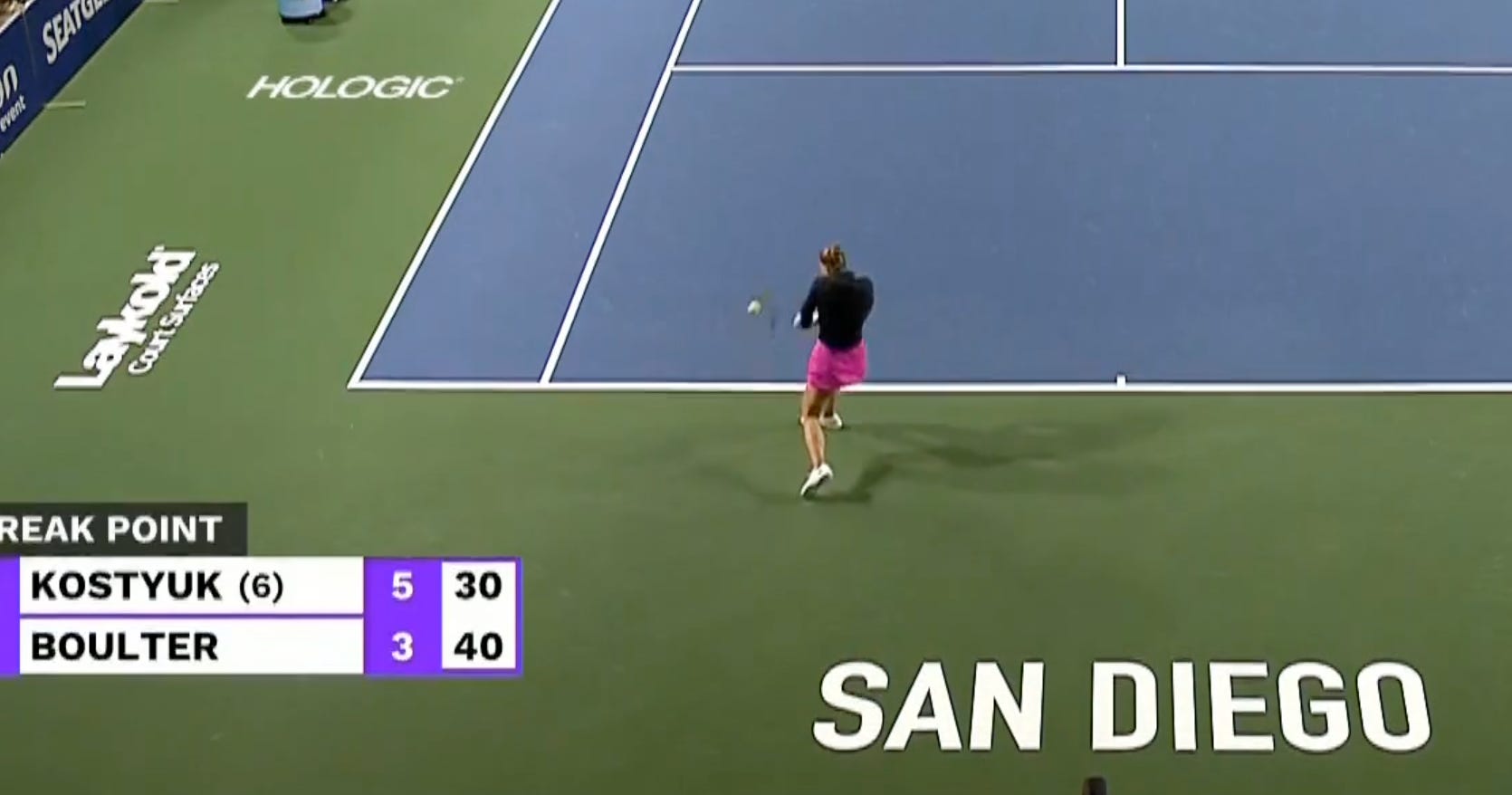
Similar to my earlier point about losing balance as a result of such a big FH swing, this is also the case with the BH swing. She frequently did this versus shorter, narrower trades and found herself swinging without enough space to her side, and then falling back inwards as she swung because neither foot created a wide enough base for her to lean on.
Her best port of call in these moments was to double down on the way she was leaning and go heavy cross to try and rush Katie’s BH, which worked a couple of times but didn’t last as a response.
In most cases, her trades from here continued to loop back up, with that left-handed shape applied from a low contact point giving Katie numerous opportunities – off the back of both FH & BH trades – to keep hitting FHs from the middle.
With the big back swing and narrow base, she found it very difficult to ever hold steady to wait to redirect the ball down the line. When she did start to go down the line instead, it was often very close to the middle. So, either she pressed long:
Or, she could only look to rush Katie’s FH, which, as alluded to, didn’t win her any prizes:
Evolution of the dynamic
A progressing factor in the trade that sured Katie’s BH up was the improvement in right leg planting. Besides Marta failing to keep on top of the rallies to assert herself in that trade, Katie adding to the ease of its drive with her footing meant she could handle +1s much more consistently and really look to disarm Marta with that shot alone.
The difference at the start of this rally is stark from the set 1 instances, as she uses the time she has to plant her right leg across when on the move both times.
The standout being the 2nd BH, which her lean in for allows her to find the outside of the ball and drive it through the short angle. The only let-down here being that Katie opts for power into the FH over placement closer to the corner, which would’ve allowed for a more effective transition to net.
With its increased stability deep into the match, it should be no wonder that Katie suffered as many unforced and forced BH errors in the 1st set (13) as she did in the last 2 sets combined. Plus, she managed 4 winners, compared to set 1’s 0.
And, tying back into the point of Marta’s BH targeting on +1s, there was even less of a way to get at Katie by this point. She was handling the guided redirects comfortably and was picking up the shortened, flatter returns off both wings by exploiting the open court left and converting them into forced errors.
By the 3rd set, Marta’s last resort was to press harder with her FH, but the consistency of Katie’s defence off both wings meant it was futile. Not to mention that Katie, who was still going strong on serve, was punishing any lapses in concentration, whilst picking off Marta’s progressively weaker 1st serves in the process.
Katie’s 2nd serve win % had risen from that 38% in set 1 to 64% in the decider, while Marta’s 1st serve win % dropped from set 1’s 79% down to 47% in the 3rd.
That level of serve-return edge was crushing given that Katie had suffocated most of Marta’s threat in the extended rallies. In the end, the 13 double faults Katie racked up were a small price well worth their fee.

Katie won 11 more points in the 0-4 shots rally range, 6 more in the 5-8, and was just edged out by 3 in the 9+ range – a figure that might’ve tilted in Katie’s favour through sets 2 & 3 alone.
With such immaculate patience against shots coming her way – rarely forcing herself to go for too much – Katie continued to impose a brand of tennis that was so balanced and dominant. She utilised the conditions perfectly, both on the day and throughout the week, to allow her FH to devastate without going overboard.
What better example to illustrate such than this point late in the encounter:
If Boulter’s able to sustain her fitness levels and smooth out the serve (reduce the ball toss) and BH (improve footwork and body distribution), then she can be a legitimate mainstay given her easy firepower and remarkable consistency.
~
If you made it this far, thanks for reading :)
All thoughts, feedback and shares are appreciated. You can also find me here.